This text should have seen the light way before it did.
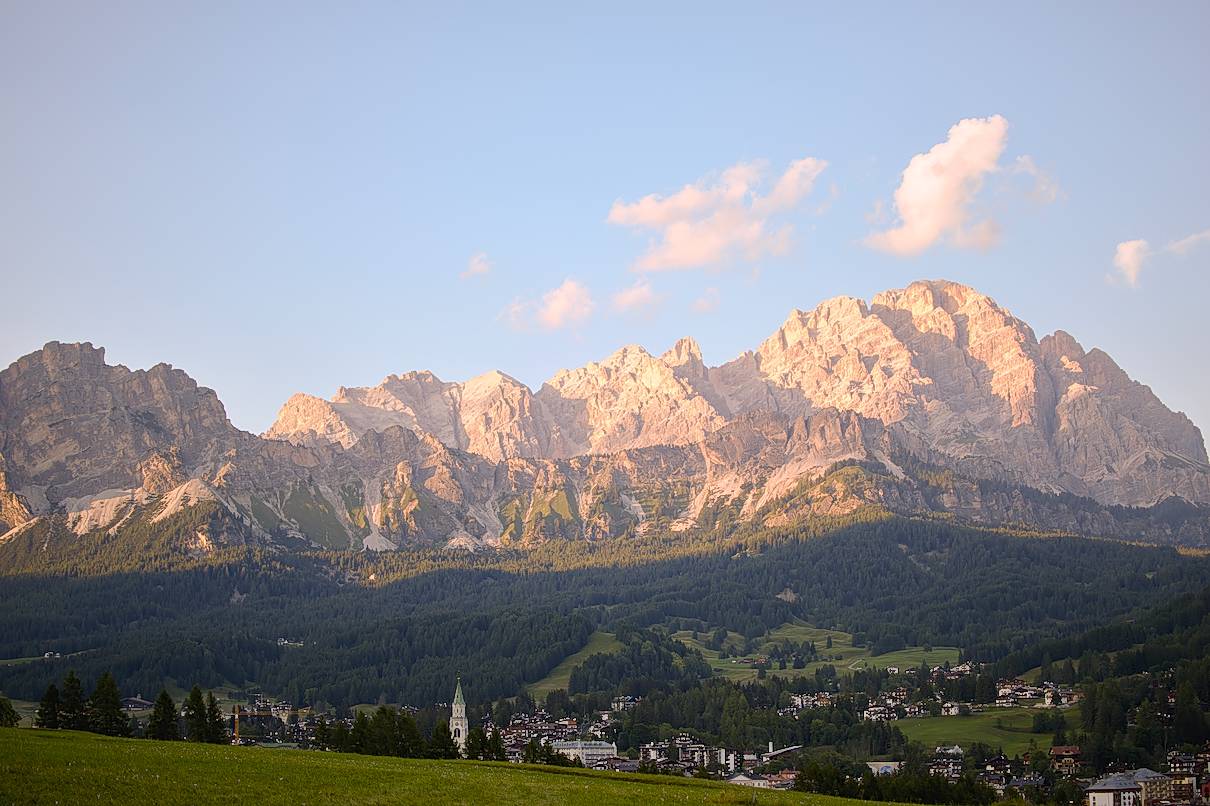
These words should have been written, pressed, felt and read way before I felt like doing this just as I raised my eyes and looked at the mount Serles that overlooks Innsbruck and the valley of the river Inn.
I will now present a story of mountains, definitions and heartbeats two steps away from touching the sky.
20th of August, 2024: the day awareness came.
Exactly on that Tuesday I set myself the goal to discover, rise, reach the top of that pyramid where for such a long time my eyes had landed as I rode my bike along the Meinhardstraße.
This is about a mountain whose name results from centuries of evolution and goes back to a phase where a minority language like the Ladin of Cortina d’Ampezzo- Anpezo needed no label, needed no grammar and needed no institutional school subject.
As a free mountain soul, I daily look for aspects of my surroundings I might want to know.
I met someone during one of those natural conversations I had at work, spoke about how the word “mountain” (or “Der Berg”) is a masculine noun in German while there is one Berg, a pyramid going against the grammar rules and rising to resemble the Dolomites where I was born. It is a 2717 metres high pyramid with some unclear etymology. I was eager to know more!
The mount Serles, German “Die Serles”, gets its name secondarily from the ancient Ladin word “suredl”, meaning sun. The sun is also a feminine noun in German as in “Die Sonne”. In Ampezzano Ladin our sun is named “soróio”, with an evident similarity to ancient Ladin “suredl”. Both words come from the same Latin root “sol”. Interestingly enough, Suredl came to be the evocative form for sun, but “Sörls”, a noun that originated from a Romance matrix and had served in written form as main toponym since the 15th century, gave the most logical imprinting to the lemma Serles.
The information board at the Serlesjöchl presented me that day with exactly this interpretation. I accepted it as it showed itself to me.
Let us read back to that Tuesday. As a language mediator and translator facing something new daily, I felt a strong pull towards a deeper understanding of the matter.
As one might say: “If you change the way you see things, what you see changes”.
With this very mindset I started the journey and walked a steep path in the Stubai valley. I was moving, maybe I ran as I usually do when on my own.
Some breaths later I was a good three-hundred metres below the “Serlesjöchl” – a pass from where you look over Steinach am Brenner. I saw a sign, as the reader might have noticed from the pictures, and understood why Serles is a feminine noun and why this starkly contradicts German’s rules. Moreover, Goethe called it the “High Altar of Tyrol”.
I instantly walked faster towards my goal.
Many peaks I could see, more Alpine choughs I could whisper to. Atop I eventually grasped what one of Germany’s biggest thinkers had described.
Another chough flew on its wings, while I flew with my mind. I had this feeling that we both, me and the bird, were alike, were equally free and in the same way risen to a safe distance from the ground. We had become friends and felt it would like my Tarallo. Cuisine unites, right?
After having slept by the summit cross, I began to make my way back down to the valley. Some clouds gathering on the Stubai glacier convinced me I should move, especially at 2717 metres above sea level. The wind blew left and right on the Nepalese flags, I was coming back, at moments running down along the path.
I had dinner with a pizza, some precious memories and tired legs, tired of the kind of tiredness that feels like a reward.
And it was exactly like this: I had found out why the name of the High Altar of Tyrol is a feminine noun. The symbol of the valley of Stubai, sovereign above the eastern alpine capital city of Innsbruck, was given an eternal name, exactly as eternal as the pyramidal figure which it fits into.
In choosing this toponym, the ancient Ladin people of the Alps were clear. Actually, diving into this discovery process I found one diamond of invaluable worth: I became aware of the fact that
mountains do not lie; they never did and never will.
Atop this mount above Fulpmes in the Stubai Valley one might still hear some ancient Ladin language being whispered.
And I write about how immeasurably valuable this is: the pure mountains where I had the privilege to grow up, with their names and shapes that cannot be reproduced, have more to say about what is around them than entire centuries of fights, disputes, conventions, agreements, attempts at peace and signed treaties will ever do.
Let us reflect on the core of my argument: mountains do not need labels, because they already lived on the defining words spoken from generation to generation starting with the Big Bang. Mountains teach us Homo sapiens to say words that are worth the gift we had been given of being conscious enough to name the elements of our human experience.
Let us not forget one important fact:
Mountains, in this era of the modern, stand very well without the definitions that cover them.
What
About
Us?
Answering this question, I believe, makes those crystal palaces tremble — the ones modern minds have built on swampy ground at the foot of the mountains, where their iron (un)certainties reside. Here speaks the “mountaineer” among us: climbing on those buildings, be they made out of thoughts or steel and glass, shall not have the same relevance as sitting by the summit cross and wondering how you reached it.
Mountains and rocks cannot talk, at least until proven otherwise. What they do very, very well is this: forcing us all to listen and remember how small we are.
They do not utter words, tell lies, nor dictate definitions.
Mountains do not fear earthquakes, while some twinkling crystal facades very much do so.
Ménego